Wednesday, May 20, 2015

Paper Please

Today, we went on our first technical visit to see three different facilities that serve the people of Cagliari and surrounding areas. These facilities are located about 20-30 minutes outside of the city and in a more industrial district. For those unfamiliar with my trip, I am currently taking a class involving resource recovery and waste management and different policies involved abroad.
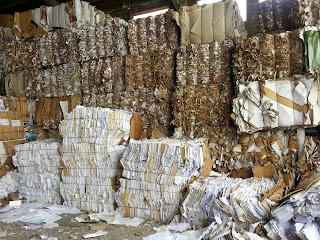
High-quality paper from industry to be recycled
Finished paper product ready to be sold
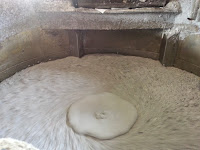
Paper-water pulp mixture
The first place that we went to was a paper and cardboard recycling facility whose end product was the corrugated part of corrugated cardboard, white paper, and other paper products such as paper bags. Most of the product that the facility produces, about 98-99%, is the corrugated cardboard/brown paper product because it is created from the societal paper waste which can be a mix of many different types of paper products. The other 1-2% of the recycling facility's production is high-quality white paper. This percentage is so low because high-quality paper must be used in order to make high-quality paper. It cannot be produced from the mix of paper products that is found in the societal waste because of the nature of the paper. Therefore, it is produced less and must be made from paper waste from industry. Today when we visited, they were creating the high-quality white paper. It is formed by going through a process that starts by mixing the paper with water creating a type of paper-water soup mixture called pulp. This is then run through a series of different sieves to make sure that all contaminants, for example binder pieces or staples, are removed from the product. Once all contaminants are removed, the water starts to be removed from the mixture slowly using gravity, pressure, and heat. The final paper is then collected and cut even on all sides and re-rolled onto cardboard rolls in order to be sold to different companies. I really enjoyed seeing this entire process first hand because paper is big part of my everyday life as a student and everywhere in our lives. I like knowing that even though I am surrounded by the use of paper, this process is fairly simple and that many places, such as the USA, can reproduce the same kind of facility in order to conserve resources.
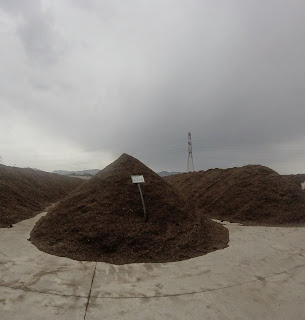
Fertilizer after decomposition
The next place that we visited was a compost facility. In the EU, it is illegal to put any type of organic waste into a landfill or incineration process. Therefore, the bio-waste must be dealt with in a different way, and one of these ways is composting. This facility receives both yard and food waste from the surrounding area and creates a fertilizer that is sold back in bulk to different places in the community. The waste comes to the facility pre-sorted, meaning that the yard waste (branches from the city, grass, etc.) and food waste (personal kitchens, restaurants, etc.) is separate. In order to create a good fertilizer a certain percentage of yard waste and food waste must be used. This mixture is sorted in order to remove plastic bags, plastic, glass, and any other contaminants. Once sorted, it goes through an oxygen and a turning process which are used to speed up decomposition. It is then moved outside where it will continue to decompose for 60 days. After this period, the quality of the fertilizer is tested in a lab and is ready to sell once the results are positive. Once getting past the smell of the facility, I thought it was really interesting because it's something that's not really talked about in the USA. I've heard of composting before, but not of any facilities that do it. One place that I have seen a food scrap bin is at my grandma's house in California, but I never really considered where the scraps go after the bin. I think that it's definitely something the USA should pursue more because of the benefits to different agricultural industries and the reduction of gases such as methane, but I can see how the process of implementing a composting program would be difficult. The cost of processing bio-waste is higher than many other types of recycling due to the nature of the product. You have the cost of bins because bio-waste must be collected separately from other waste and the cost of pick up, which must be high than any other type of collection because no one wants smelly garbage in their house for more than a couple of days. Currently, the city of Cagliari has general community dumps located on the streets, but they will be starting home collection by September. It will definitely change how the waste management system function and hopefully with help them produce less waste that has to be incinerated or landfilled.
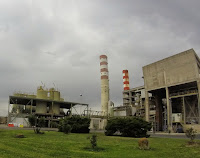
WTE facility
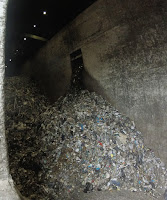
Solid waste to be incinerated
The last facility we visited was a WTE or waste to energy place than took regular municipal solid waste and also industrial waste and turned it into energy using incineration. What I thought was the most interesting about the plant was how they actually produced enough electricity to power all of the facilities in the area, such as the compost facility and themselves, while still selling the remaining electricity back to the electric company. It was definitely not the cleanest process or the safest especially with all the chemicals that were involved, but it still reduced the amount of waste that went into a landfill. Many landfills are preferred in the USA due to cost, but in Europe there isn't the space for them. This has led the EU to create strict policies and regulations on waste and allowed them to find alternatives to landfilling which the USA should follow in my opinion.
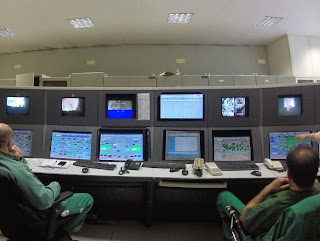
Control room of WTE facility
Today was pretty exhausting, and thinking about it, many people wouldn't have enjoyed it too much. For me, it really interesting. I take this as a good sign since I haven't really taken any classes in civil engineering yet. Although it isn't the most glamorous part of the island, it's still very important in order to keep Sardenga beautiful for years to come, like the beach we visited over lunch!

Tuesday, May 19, 2015

Cavallini and Nuraghe

Here are some picture from the culture excursion we went on on Sunday. We visited Casa Zapata, Barumini, a nuraghe, and Parco della Giari. Nuraghe are structures found all of the island of Sardenga. They're old stone structures whose exact purpose is unknown. Around 30,000 are though to have existed, but now only about 7,000 are left due to people taking the stones for other purposes throughout the years. We visited the largest nuraghe, and also the nuraghe that happened to be the structural base for Casa Zapata.

Church right in front of Casa Zapata
Nuraghe that Casa Zapata was built on
Largest nuraghe in Sardenga
View from the top of the nuraghe, would have been houses
Inside the nuraghe, one of the four towers
After touring the nuraghe, we went hiking on the volcanic plateau created into a park called Parco della Giari. It is about 30 sq. miles, and from here we hiked around and saw the wild cavallini of Sardenga. Cavallini means little horses in Italian, and they are quite small with the average height being around 4 ft. Their population is only around 700, and they are specific to the island. Besides the great views, we also visited small houses used by the shepherds many years ago. The culture here on the island is interesting because of its diversity from area to area and to have the opportunity to visit many different parts of the island is an amazing.

View from the plateau 
Un cavallino 
Little shepherd house

Sunday, May 17, 2015

Tre Giorni: Pizza, Dialogo, e Italiano

After only three days here in Italy, we have already explored and seen so many different things that it seems as if we have been here for at least a week. The streets that we have walked each day are becoming more and more familiar, and some of the shops that we have explored are becoming favorites.Yet, there is still so much to learn about the island, town, and culture.

The center of Cagliari from above the domitory
When we first arrived, it was definitely apparent that we were not in Boston anymore after the humidity in the air and the shining sun hit us as we stepped off of the plane. Everyone was very tired after the two plane flights, but we were also anxious to explore the new place that we would be calling home for the next month. After settling into the guest house and being slightly overwhelmed with the Italian we had barely begun to hear, we headed out to dinner as a group to the square down the street. The Piazza Yenne is a plaza down the road from our dormitory that has many different restaurants and is constantly filled with people relaxing and enjoying each others company. It's a very common place to meet people, old and young alike. Here is where we had our first dinner and afterwards enjoyed gelato while wandering down a few streets comprehending how a couple hours on a plane could result in us actually being in Cagliari, Italy.

The next day we visited Universitá di Cagliari and met with other environmental engineering students from the university as well as a group of students visiting from the Universitá di Padova which is located near Venice. Here we listened to three lectures, one professor from each of the Italian universities and a lecture from Professor Onnis-Hayden. These presentations discussed the issues in waste management and resource recovery in mostly Sardegna, but much of Italy as well. We also had presentations from students about student life and academics in each of the universities. After this, we had discussions that related to the differences in the school systems such as how the students were learning, the amount of tests given, how many tests, and the future of environmental engineering careers and whether having a job was better at home or abroad. This was a great chance to learn about the other engineering programs and how they differed from ours in the USA. We also had a chance to argue on teams about which way was better when discussing the two academic systems and learn more about the Italian system that we had no idea about. One of the major differences that stood out was how their program is three years of undergraduate work and then two years of graduate work. Almost everyone does the graduate program because of the standards of the country, whereas in the USA, we only have four years (usually) of undergraduate work and then some people go on to a graduate program. It was a lot of fun to interact with these students because we were both curious about each other's backgrounds and cultures. I thought the most interesting thing was how well they all spoke English, and even when there were misunderstandings, we were able to figure out how to communicate our ideas. That night, we had a 13 course meal that included some of the most traditional dishes of the island. We sat for more than three hours eating and enjoying all of the food and our time in Italy. A lot of the seafood I had never tired before, but it was all delicious and better than I had anticipated.
The "Antipasta" or appetizers of our 13 course meal


On Sunday, we used the morning to get some much needed rest because of the time difference. In the afternoon, we were invited to visit the Universitá di Padova students at the beach house they were staying at. Here we were able to speak more with the students and learn about them each individually and talk about cultural and academic differences. Of course, everyone enjoyed the crystal clear Mediterranean Sea and the party as well.

Mediterranean Sea from the beach house 
So far Italy has been amazing and the people have been so open and welcoming. I keep feeling bad that my Italian is little to nonexistent, but I keep trying which is what matters. In the restaurants, with the tour guides, and even with the security guard it's important to practice the little bit that I do know. We aren't necessarily here to learn the language, but I consider it to be a very big part of the culture and important in cultural understanding. Cagliari has exceeded any expectations that I had, and I can't wait to learn more about our topic as well as the long history and culture of the island.

Wednesday, May 6, 2015

Packing and Preparing

As I continue my preparations for my trip to Italy, I can't help but think about all of the different things I am about to experience. I have already been to Italy once before for a 10 day trip, but that was all over the country where I never spent much time in a single city. On the island of Sardinia, I think that it will be warm and the people will be very open and outspoken. I know a couple of people from Cagliari, and they are both super nice girls that are outspoken and loud. They are very helpful and open to others though. Any preconceived notions I have about Italians, especially from this location, come from the time I spent with these two girls. I also think that having a Latin-based language makes me think that Italy will be similar to both Brazil and other Latin American countries, but with more of a European touch. The culture might also be very traditional as the country itself is much older than any South American country. I also think that a lot of the culture might revolve around being around other people as well as food. 

For me, the idea of being immersed in another culture isn't something that I am completely unfamiliar with. I spent my junior year of high school abroad in Brazil for 11 months and upon arriving had very little background in the culture and the language. I assume this will be similar to the experience that I am about to have in Italy. Even though I am not familiar with the Italian language, I hope that I can figure out enough to get by in the city. I also hope to draw on both my Spanish and Portuguese backgrounds even though they are not exactly the same languages. When I first arrived in Brazil, I remember everything was confusing to me, and I was constantly frustrated because I couldn't express myself in the way that I wanted. Now looking forward to Italy, I know that at times I will be frustrated and not know what to say. I know that I might and probably will make cultural mistakes. But from these, I hope to learn and grow and adapt myself to the Italian culture. In order to experience everything to the fullest, I hope to get out as much as possible and interact with as many people as possible. I also hope to try many new things that are considered local or traditional. 

As the date comes closer, I can't wait to experience the Italian culture and all this dialogue has to offer both academically and culturally. Andiamo!